


.jpg)
I. WHAT IS CFR IN INCOTERMS?
CFR (abbreviation for: Cost and Freight) is a term in international trade that specifically stipulates the corresponding obligations, costs and risks involved in the transfer of goods from seller to buyer according to Incoterms standards published by the International Chamber of Commerce (ICC).
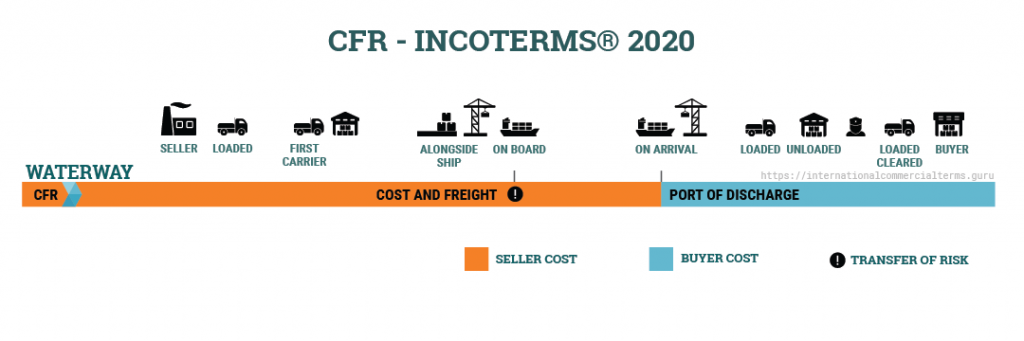
Under CFR terms, the seller must either deliver the goods on board the vessel or procure the goods already so delivered. The risk of loss or damage to the goods transfers when the goods are on board the vessel. The seller must contract and pay the costs and freight necessary to bring the goods to the named location. With this condition, the seller owes no obligation to the buyer to purchase insurance cover, so if necessary, the buyer would be well-advised therefore to purchase some insurance cover for goods to avoid risks.
How to include CFR conditions on foreign trade contracts:
CFR [named destination] Incoterm ® 2020
For example, if the delivery location specified by the buyer is at Tien Sa port, Da Nang, located at 01 Yet Kieu, Tho Quang, Son Tra, Da Nang. The CIP of this foreign trade contract will be written as follows: CFR 01 Yet Kieu, Tho Quang, Son Tra, Da Nang, Vietnam Incoterms 2020.
II. USAGE GUIDES
1. Regarding transportation methods: This term shall be used for sea and inland waterway transportation. The CFR is not suitable where the goods are delivered to the carrier before they are delivered on board the vessel, for example in a container, which is usually delivered at a container terminal. In such cases the CPT terms should be used.
2. Transfer of goods and risks (CFR – Cost and Freight): Cost and Freight means that the seller must deliver the goods on board the vessel or purchase goods for such delivery. Risk of loss or damage to the goods is transferred when the goods are delivered on board the vessel. The seller must contract and pay the costs and freight necessary to bring the goods to the named location.
According to these terms, the seller owes no obligation to the buyer to purchase insurance cover, so if necessary, the buyer would be well-advised therefore to purchase some cover for the goods to avoid risks.
This condition has two important ports: the port of departure where the goods are delivered on the carrier and the destination port. Risk transfers from seller to buyer when the seller delivers the goods to the buyer by placing them on board the vessel at the shipment port or by purchasing the goods already so delivered. However, the seller will still be responsible for signing a transportation contract to bring the goods from the port of departure to the port of destination.
This condition has two tipping points, because migration risk and costs are distributed at two different places. While the contract always specifies the port of destination, it may not specify the port of loading - which risks are transferred to the buyer. If the port of shipment has special significance for the buyer, the parties should specify as clearly as possible in the contract the place of delivery.
The parties should also specify as clearly as possible the point at the named destination, as the costs to that point are for the seller's account. The seller should sign transportation contracts to this exact location. If according to the contract of carriage, the seller must bear the costs related to unloading the goods at the destination port, the seller shall not be entitled to recover those costs from the buyer unless otherwise agreed between the parties.
3. If there are many carriers involved: It often happens that many carriers participate in transporting goods through many ports during the transportation process. For example, the first carrier will control the feeder ship carrying goods from Hong Kong to Shanghai, then the goods will be transferred to the main carrier carrying goods to Southampton. The question here is will the risk be transferred from the seller to the buyer in Hong Kong or Shanghai? The parties can negotiate this themselves and rely on the contract. However, if no agreement is concluded, the default place where risk in the goods passes is when the goods are delivered to the first carrier, which in this case will be Hong Kong. If the two parties want the transfer location to be Shanghai or some other location, the parties can add this to the contract.
4. Unloading costs at place of destination: If the contract of carriage signed by the seller includes unloading costs at the destination port, the seller will have to pay these costs, unless the two parties have agreed in advance that the buyer will refund this cost to the seller.
5. Export/import customs clearance obligations: The CFR terms require the seller to clear the goods for export, if necessary. However, the seller is not obliged to carry out customs clearance when importing or transiting in a third country that the goods must go through, and does not have to pay import taxes or import customs clearance costs.
A. OBLIGATIONS OF THE SELLER:
A1. General obligations of the seller
The seller must deliver the goods and the commercial invoice in accordance with the sale contract and provide information, documents as the contract may require.
Any documents provided by the seller may be in paper form or in electronic form if agreed by the parties or prescribed by custom.
A2. Delivery
The seller must deliver the goods either by placing them on board the vessel or by procuring the goods so delivered. The seller must deliver the goods on the agreed date or within the agreed period and in the manner customary at the port.
A3. Risk transfer
The seller bears all risks of loss or damage to the goods until they have been delivered in accordance with A2, except in cases of loss or damage referred to in B3.
A4. Carriage
The seller must contract to transport the goods to the agreed place of delivery, if any, at the place of delivery to the named port of destination, or to any point within the port of destination. The contract of carriage must be made on usual terms, at the seller's cost, and must carry the goods by usual route by a vessel of the type normally used for the transport of those goods.
A5. Insurance
The seller has no obligation to the buyer regarding contract insurance. However, the seller must provide the buyer, at the buyer's request, risk and cost, with information in the possession of the seller that the buyer needs for obtaining insurance.
A6. Delivery/transport document
The seller must, at its own cost, provide the buyer with the usual transport document for the agreed port of destination.
This transport document must show the conformity of contract goods, be dated within the period agreed for shipment, enable the buyer to claim the goods from the carrier at the port of destination and, unless otherwise agreed, enable the buyer to sell the goods in transit by the transfer of the document to a subsequent buyer or by notification to the carrier.
When such a transport document is issued in forms that can be transferred and include original documents, a full set of originals must be presented to the buyer.
A7 Export/import clearance
a) Export clearance
Where applicable, the seller must carry out and pay for all export clearance formalities required by the country of export, such as:
- Export licenses:
- Security clearance for export
- Pre-shipment inspection;
- and Any other official authorization.
b) Assistance with import clearance
Where applicable, the seller must assist the buyer, at the buyer's request, risk and cost, in obtaining any documents and/or information related to all transit/import clearance formalities, including security requirements and pre-shipment inspection, needed by any country of transit or the country of import.
A8. Checking – Packaging – Marking
The seller needs to pay the costs of inspection (such as quality inspection, weighing, measuring, counting) necessary for delivery as prescribed in section A2.
The seller must package the goods at their own expense unless industry practice specifically requires that the goods be sent unpackaged.
The seller must package and mark the goods in accordance with the mode of transport, unless both parties have specifically agreed on packaging and marking when the contract is signed.
A9. Cost division
Seller must pay:
a) All costs relating to the goods until they are delivered to the buyer in accordance with section A2, except those payable by the buyer in accordance with section B9;
b) Transportation costs and all related costs arising from section A4, including loading costs and costs related to transportation security;
c) Any additional charges for unloading at the destination port but they must be in the contract of carriage that the seller signs with the carrier
d) Transit costs if these costs are included in the transport contract signed by the seller;
e) The costs of providing evidence to the buyer in accordance with A6 that the goods have been delivered;
f) If necessary, customs clearance, export tax payment and any other costs related to export according to item A7 (a); and
g) Pay the buyer all costs and charges relating to assisting the seller in obtaining the necessary documents and information under B7 (a).
A10. Notifying the buyer
The seller must notify the buyer that the goods have been delivered in accordance with A2 and must also notify the buyer of any information necessary to enable the buyer to take delivery of the goods.
B. OBLIGATIONS OF THE BUYER:
B1. General obligations of the buyer
The buyer must pay for the goods as stipulated in the sales contract.
Any documents provided by the buyer may be in traditional paper form or in electronic form if agreed by the parties or prescribed by custom.
B2. Taking Delivery
The buyer must take delivery of the goods when they have been delivered in accordance with A2 and must take delivery of the goods from the carrier at the named place of destination or if agreed, at a point at that destination.
B3. Risk transfer
The buyer must bear all risks related to loss or damage to the goods from the time the goods are delivered according to section A2.
If the buyer fails to give notice in accordance with Clause B10, the buyer bears all risks of loss of or damage to the goods from the agreed date or the expiry of the agreed delivery period, provided that the goods have been clearly identified as the contract goods.
B4. Carriage
The buyer has no obligation to the seller to make a contract of carriage.
B5. Insurance
The buyer has no obligation to the seller to obtain insurance for the goods.
B6. Transport/delivery documents
The buyer must accept the transport documents provided in accordance with A6 if they comply with the contract.
B7. Export/import customs clearance
a) Supporting export customs clearance
If necessary, the buyer must assist the seller at his request, at the seller's risk and expense, in obtaining documents/information relating to export clearance, including security or Pre-export inspection required by the exporting country.
b) Import customs clearance
If necessary, the buyer must carry out and pay the costs related to customs clearance specified in the transit country and the importing country, such as:
- Import permit or any permit required for transit;
- Security checks for import and transit;
- Goods inspection; and
- Any legal regulations.
B8. Checking – Packaging – Marking
The buyer has no obligations to the seller.
B9. Cost division
Buyer must:
a) Pay all costs incurred related to the goods from the time the goods are delivered according to section A2, except for the costs paid by the seller according to section A9;
b) Costs of transit of goods, unless they are included in the transport contract signed by the seller;
c) Unloading costs, unless they are included in the transport contract entered into by the seller;
d) Refund all costs and fees incurred by the seller in helping the buyer according to section A5 or A7 (b);
e) If required, pay all taxes, fees and other charges as well as customs clearance fees for transit and import in accordance with section B7(b );
f) Pay all costs arising from failure to promptly notify the seller in accordance with B10, from the date specified or the date of expiry of the period specified for dispatch, provided that the goods have been identified as the contract goods.
B10. Notifying the seller
In cases where the buyer has the right to decide on the time of delivery and/or the place of destination or the point of receipt at that destination, the buyer must give the seller full notice thereof.
Here are the advantages and disadvantages of CFR terms:
|
Advantages |
Disadvantages |
|
1. The seller is responsible and costs for transporting goods to the destination port, helping the buyer save costs and time in transporting goods.
2. Procedures for exporting goods and transporting them to the port are managed and controlled by the seller, helping to reduce responsibility and work for the buyer.
3. CFR is a common and easy-to-understand delivery condition, therefore it minimizes the risk of disputes between parties.
|
1. The buyer is responsible and liable for the transportation of the goods from the port to their final destination.
2. The buyer shall bear the sole responsibility and costs associated with importing the goods into their country, including taxes and fees related to importation.
3. The buyer may encounter difficulties in managing and handling customs procedures and related to transporting goods from port to final destination. |
Therefore, when using CFR terms, the buyer needs to have knowledge and experience in transportation management and import procedures. At the same time, it is necessary to ensure that the seller uses reputable shipping services and ensures safe and on-time delivery. In addition, the parties should also pay attention to factors such as costs and responsibilities during the transportation of goods.
Above is a summary of information to help you better understand the CFR Incoterms ® 2020 conditions. In general, in commercial activities, each condition clearly shows the responsibilities of the seller and the buyer. Therefore, if you have any questions and need any advice on import and export of goods, you can contact FDVN for legal support.
(1).jpg)
CONTACT US:
Lawyers in Da Nang:
99 Nguyen Huu Tho, Quan Hai Chau, Da Nang city
Lawyers in Hue:
366 Phan Chu Trinh, Hue City, Thua Thien Hue
Lawyers in Ho Chi Minh City:
No. 122 Dinh Bo Linh Street, Binh Thanh District, Ho Chi Minh City
Lawyers in Ha Noi:
Room 501, 5th Floor, No. 11, Lane No. 183, Dang Tien Dong Street, Dong Da District, Ha Noi
Lawyers in Nghe An:
No. 19 V.I Lenin street, Vinh City, Nghe An Province
Website: www.fdvn.vn www.fdvnlawfirm.vn www.diendanngheluat.vn www.tuvanphapluatdanang.com
Email: fdvnlawfirm@gmail.com luatsulecao@gmail.com
Phone: 0935 643 666 – 0906 499 446
Fanpage LUẬT SƯ FDVN: https://www.facebook.com/fdvnlawfirm/
Legal Service For Expat: https://www.facebook.com/fdvnlawfirmvietnam/
TỦ SÁCH NGHỀ LUẬT: https://www.facebook.com/SayMeNgheLuat/
DIỄN ĐÀN NGHỀ LUẬT: https://www.facebook.com/groups/saymengheluat/
Youtube: https://www.youtube.com/c/luatsufdvn
Telegram: https://t.me/luatsufdvn
Group “Legal forum for foreigners in Vietnam”: https://www.facebook.com/groups/legalforeignersinvietnam
Other Articles
- NGHỊ ĐỊNH SỐ 385/2026/NĐ-CP CỦA CHÍNH PHỦ VỀ KIỂM SOÁT THỦ TỤC HÀNH CHÍNH
- VENTURE CAPITAL MODEL AGREEMENT WITH COMMENTARY: A CLAUSE-BY-CLAUSE GUIDE FOR LAWYERS IN ANY JURISDICTION BY HERMAN, HENRY & DOMINIC
- NGHỊ ĐỊNH 371/2026/NĐ-CP QUY ĐỊNH CHI TIẾT VIỆC TUYỂN DỤNG, QUẢN LÝ NGƯỜI LAO ĐỘNG VIỆT NAM LÀM VIỆC CHO CÁC TỔ CHỨC, CÁ NHÂN NƯỚC NGOÀI TẠI VIỆT NAM
- THỦ TỤC XIN CẤP LÝ LỊCH TƯ PHÁP CHO NGƯỜI NƯỚC NGOÀI 2026 / PROCEDURES FOR OBTAINING CRIMINAL RECORDS FOR FOREIGNERS IN 2026
- THỦ TỤC HƯỞNG BẢO HIỂM XÃ HỘI MỘT LẦN CHO NGƯỜI NƯỚC NGOÀI 2026 / PROCEDURES FOR LUMP-SUM SOCIAL INSURANCE ALLOWANCE FOR FOREIGNERS IN 2026
- THE HAPPY LAWYER: MAKING A GOOD LIFE IN THE LAW BY NANCY LEVIT & DOUGLAS O.LINDER
- VIETNAM INVESTMENT PROMOTION GUIDEBOOK 2026 BY VIETNAM TRADE PROMOTION AGENCY - MINISTRY OF INDUSTRY AND TRADE
- THE COMMERCIAL LAWYER'S MIND: UNDERSTANDING BUSINESS WITHOUT BECOMING A BANKER (A PRACTICAL GUIDE FOR LAW STUDENTS AND JUNIOR COMMERCIAL LAWYERS) BY BY HERMAN, HENRY & DOMINIC
- QUY ĐỊNH VỀ KHOẢN VAY NƯỚC NGOÀI, HỒ SƠ, THỦ TỤC ĐĂNG KÝ KHOẢN VAY NƯỚC NGOÀI VỚI NGÂN HÀNG NHÀ NƯỚC / REGULATIONS ON FOREIGN LOANS, DOSSIER AND PROCEDURES FOR REGISTRATION OF FOREIGN LOANS WITH THE STATE BANK
- BÀI HỌC TIẾNG ANH PHÁP LÝ: IN VIEW OF
- TỔNG HỢP 10 BẢN ÁN CỦA TOÀ ÁN VƯƠNG QUỐC ANH GIẢI QUYẾT TRANH CHẤP QUYỀN SỞ HỮU TRÍ TUỆ ĐỐI VỚI PHẦN MỀM / COLLECTION 10 UNITED KINGDOM COURT JUDMENTS ON SOFTWARE INTELLECTUAL PROPERTY DISPUTES
- TỔNG HỢP 12 BẢN ÁN CỦA TÒA ÁN SINGAPORE VỀ AI, BLOCKCHAIN, TIỀN ĐIỆN TỬ VÀ TÀI SẢN SỐ / COLLECTION 12 SINGAPORE COURT JUDGMENTS ON AI, BLOCKCHAIN, CRYPTOCURRENCY AND DIGITAL ASSETS
- TỔNG HỢP CÁC MẪU HỢP ĐỒNG THỬ VIỆC VÀ HỢP ĐỒNG CÓ ĐIỀU KHOẢN THỬ VIỆC TRÊN THẾ GIỚI / COLLECTION OF PROBATIONARY EMPLOYMENT CONTRACT TEMPLATES AND EMPLOYMENT CONTRACT TEMPLATES CONTAINING PROBATIONARY CLAUSES AROUND THE WORLD
- WINNING THE TRIBUNAL (ADVOCACY, STRATEGY, AND PERSUASION BEFORE THE ARBITRAL TRIBUNAL) BY HERMAN, HENRY & DOMINIC
- THE CONTRACT CLAUSE DICTIONARY (MODEL DRAFTING FOR THE CLAUSES THAT RECUR ACROSS COMMERCIAL PRACTICE WORLD WIDE) BY HERMAN, HENRY & DOMINIC
- BLACK'S LAW DICTIONARY (ABRIDGED TENTH EDITION) BY BRYAN A.GARNER


