


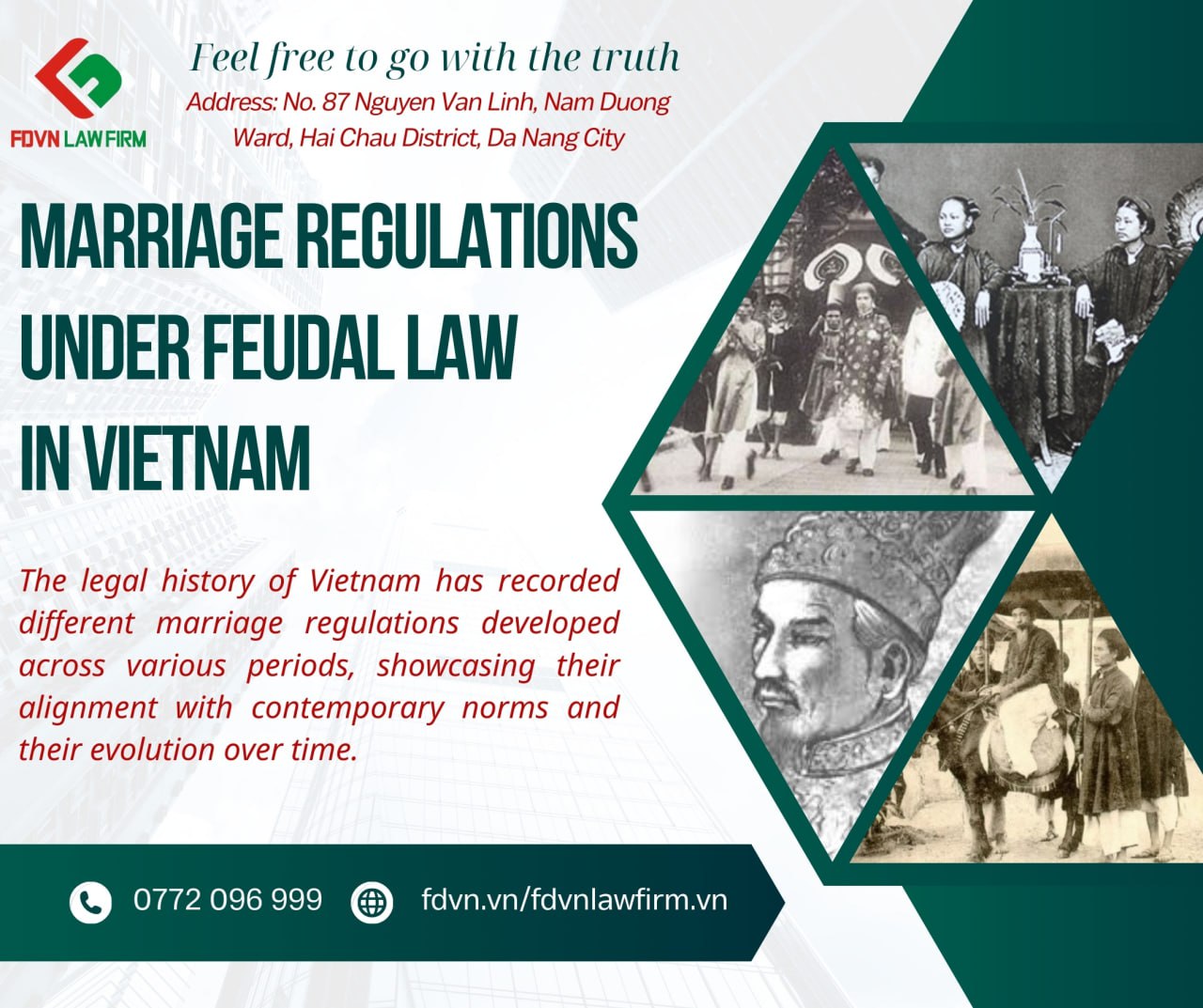
Abstract: Marriage is a union between individuals based on emotional, social, or religious foundations that establishes a relationship recognized as husband and wife within a familial context. Throughout human history, marital relationships have existed in various forms, including polygamous marriages, where one individual may have multiple spouses-monogamous marriages, and same-sex marriages… The establishment of marriage regulations comprises a set of legal norms promulgated to govern the relationship between spouses in society, reflecting the prevailing ideologies and perspectives of the time. The legal history of Vietnam has recorded different marriage regulations developed across various periods, showcasing their alignment with contemporary norms and their evolution over time. This article analyzes aspects of marriage within the legal system of marriage during the feudal era in Vietnam, highlighting the essence, limitations, and advancements of the marriage institution in that period.
Keywords: Marriage regulations, Feudalism, Vietnam.
Introduction:
The feudal period in Vietnam spanned from 939 to 1858, marked by the rule of ten feudal dynasties: the Ngô Dynasty (939-965), the Đinh Dynasty (968-980), the Early Lê Dynasty (980-1010), the Lý Dynasty (1010-1225), the Trần Dynasty (1226-1400), the HồDynasty (1400-1407), the Early Lê and Later Lê Dynasties (1428-1527), the Mạc Dynasty (1527-1593), the Tây Sơn Dynasty (1789-1802), and the Nguyễn Dynasty (1802-1954). During the Ngô, Đinh, and Lê Dynasties, the state lacked a formal legal system[1]. The Lý, Trần, Lê, and Nguyễn Dynasties marked significant developments in feudal society and traditional Vietnamese culture, laying the groundwork for the first legal codes of the feudal state, including the Lý Dynasty's Criminal Code, the Trần Dynasty's National Criminal Code, the Lê Dynasty's Criminal rules (also known as the Hồng Đức Code), and the Nguyễn Dynasty's Hoàng Việt Rules (also known as the Gia Long Code).
Feudal laws primarily emphasized criminal institutions and the rights of the ruling class; however, over time, marriage regulations emerged, mostly relating to prohibitions.
1. Overview of marriage regulations in the feudal legal system of Vietnam
1.1. The Lý Dynasty's Criminal Code
The Lý Dynasty's Criminal Code was promulgated by King Lý Thái Tông during the Lý Dynasty in 1042 and is regarded as the first legal code in the history of Vietnam. In terms of documentation, the original text of this code no longer exists; however, some of its contents have been preserved in historical records. According to the Complete Annals of Đại Việt, the Criminal Code of the Lý Dynasty is a collection of codified laws that includes regulations on the organization of the court, the military, and the bureaucracy; provisions for punishment of acts harmful to society; regulations concerning property ownership and land transactions; and taxation rules. Following its enactment, the Lý Dynasty implemented procedural regulations for atonement and established additional provisions.
Regarding marriage regulations, historical records indicate that the Lý Dynasty's Criminal Code does not contain clear provisions binding the marital relationship between husband and wife.
1.2. National Criminal Code
In 1230, King Trần Thái Tông promulgated the National Government System (“Quốc triều thông chế”), which regulated the organization of government. This code underwent several amendments and additions, leading to the issuance of the National Criminal Code by the Trần Dynasty[2]. According to historical records, the main content of the National Criminal Code during the Trần Dynasty period consists of three key areas related to criminal law, addressing offenses such as theft, adultery, and other forms of deceit; class and social stratification; and agricultural matters. The provisions concerning marriage are not distinctly articulated in this legal code.
1.3. The Lê Dynasty’s Criminal Code also known as Hồng Đức Code
In 1483, King Lê Thánh Tông decided to gather the officials to compile an official legal code for his dynasty, commonly referred to as Hồng Đức Code. In the 17th and 18th centuries, this legal code was amended and supplemented, and issued under the name The Lê Dynasty’s Criminal Code[3]. This code is considered a significant inheritance and unique innovation of prior legal achievements, marking a high level of development in the feudal legal thought of Vietnam. Regarding the provisions on marriage, The Lê Dynasty’s Criminal Code includes fairly clear regulations that reflect the perspectives of that era. The marriage provisions are located in Chapter Marriage and Family (“Hộ Hôn”) of Volume III, which governs relationships such as marriage and termination of marriage (due to death or divorce).
The fundamental principles in the legal provisions of this period still reflect feudal ideologies, such as imposed marriage, polygamy, and inequality between spouses. However, there are some progressive elements, such as the emphasis on family order and the protection of the rights of parents, husbands, and first wives, with a slight inclination toward safeguarding human rights and women's rights compared to previous times.
First, regarding marital relationships
In terms of marriage conditions, the Lê’s Dynasty Criminal Code established several prominent regulations concerning the conditions and limitations on marriage. These include: a person in mourning for a parent or spouse who marries during the mourning period will be sentenced to penal servitude (Article 317); marriage is not allowed when a grandparent, parent, or spouse is in detention or imprisonment, and if they consent, no feast or celebration is permitted (Article 318); marriage is forbidden between close relatives (Article 319); brothers, students, or siblings are not allowed to marry the wife of a deceased brother, teacher, or sibling (Article 324). Further regulations on marriage are found in Articles 316, 323, 334, 338, and 339 of the National Criminal Code.
The Lê’s Dynasty Criminal Code does not specify the legal marriage age; however, in “Thiên Nam Legal Book” (“Thiên Nam Dư Hạ Tập” - a legal book from the Early Lê’s Dynasty, compiled by Đỗ Nhuận and Thân Nhân Trung during the reign of King Lê Thánh Tông), the section on Hồng Đức marriage regulations states: "A boy must be 18 years old, and a girl must be 16 years old to marry." Therefore, it can be acknowledged that there were certain age restrictions on marriage during this period.
Regarding the form and procedure of marriage, the Lê’s Dynasty Criminal Code set out specific requirements for engagement and marriage procedures, such as: The person intending to marry must bring the complete bridal gifts to the house of the bride’s parents (if her parents are deceased, the gifts must be brought to the head of the family or the village elder) to seek permission (Article 314); If the bridal gifts (money, silk, gold and silver, pigs, wine) have been accepted, the bride’s family is obliged to marry off their daughter. If the groom’s family, after presenting the bridal gifts, decides not to proceed with the marriage, they will be fined and forfeit the gifts (Article 315). A betrothed girl may petition the authorities to return the bridal gifts before the marriage if the groom becomes disabled, commits a crime, or squanders his family’s property. If the bride becomes severely ill or commits a crime, the gifts are not required to be returned (Article 322). Beyond these provisions, the Lê’s Dynasty Criminal Code does not provide further details on the marriage ceremony or state involvement in the marriage process.
Second, spousal property relations
The "Household and Marriage" chapter of the Lê’s Dynasty Criminal Code does not clearly define spousal property relations; however, several articles in the "Lands and Property" chapter address certain aspects of these relations.
Article 374 of the law provides that if the husband dies first without a will, the property should be inherited by the children of the first wife or the husband’s prior children. A progressive point in this provision, which remains relevant today, is that if the property was jointly created by both husband and wife, it is to be divided into two equal parts - each party receiving half. This reflects a legal perspective somewhat similar to modern law. However, after dividing the property, the husband's portion is distributed as before, with the first wife's portion reserved for her children, while the second wife's portion becomes her own private property. Thus, if both the husband and the first wife die, the property is left for the children. Articles 375 and 376 further regulate the division of property in cases where the couple is childless, or where one spouse dies without a will, as well as in situations where the couple has children, and one spouse and later the children also pass away.
In general, spousal property relations in this code were in their early stages of regulation, mostly concerning land and property. Although the provisions were still rudimentary and lacked clarity and comprehensiveness, they represented a significant advancement compared to previous legal systems.
Third, on the termination of marriage
In the Lê’s Dynasty Criminal Code, wives are not allowed to unilaterally leave their husbands. Specifically, Article 321 stipulates that if either the first wife or a concubine leaves her husband's household without permission and remarries, she shall be sentenced to penal servitude, and her person and property must be returned to her former husband’s household.
Marriage during this period could be terminated under the following four circumstances: First, termination due to the death of a spouse: Although not directly stated, this is implied in Articles 2 and 320 of the code, which allow the husband to remarry after the wife’s death, while the wife could only remarry after completing her mourning period for her deceased husband. Second, forced divorce due to violations of marriage prohibitions: Divorce was required in cases where parties violated prohibitions on marriage, as specified in Articles 317, 318, 323, 324, and 334. These include cases such as marrying while in mourning for one’s parents, marrying while one’s parents or grandparents were imprisoned, officials and subordinates marrying singers, or officials marrying the daughters of tribal chiefs on the frontier. Third, divorce due to the wife’s fault: According to Article 310, the husband could divorce his wife if she violated the "absolute duties," meaning the end of marital grace and obligations. If the husband chose not to divorce despite the wife’s fault, she would be punished. Fourth, divorce due to the husband’s fault: Under Articles 308 and 333, the wife had the right to petition the authorities for divorce if her husband neglected her for five months without any contact (or one year if they had children) or if the husband unjustly insulted her parents.
Thus, the Lê’s Dynasty Criminal Code clearly reflects the class nature of feudalism, with inherent limitations in the mindset of that era, particularly in the treatment of marriage as linked to punishment and the protection of men’s rights over women’s. However, there were progressive elements, such as promoting family traditions, moral values, and a slight inclination toward protecting women’s rights.
1.4. Hoàng Việt Rules, also known as Gia Long Code
In 1811, the Governor-General of Bắc Thành was ordered to preside over the drafting of a new legal code for the Nguyễn Dynasty. By 1815, this code was promulgated under the title “Royal dynasty Rules” (also known as “Gia Long Code”) [4]. It is considered one of the two most comprehensive legal codes of the feudal period. The provisions on marriage were outlined in Volume 7, "Household Law" (Hộ luật), under the chapter on Marriage, which consisted of 16 articles.
First, about marital relations
For conditions for marriage, the Gia Long Code stipulates several provisions related to the requirements for entering into marriage:
– Marriageable age: Article 94 of the Gia Long Code mentions the marriageable age for males and females, stating that they must meet a certain age threshold, though the specific age is not explicitly defined in the law. According to the Book of Rites, the minimum age for marriage is 16 for boys and 14 for girls, and any marriage below these ages is prohibited[5].
– Consent of both parties and their parents: As stipulated in Article 109, a son or daughter cannot act against the orders of their guardians or the decisions of those responsible for arranging the marriage, such as grandparents, parents, uncles, aunts, elder brothers, or elder sisters, including maternal grandparents. Thus, the law during this period emphasized the importance of parental and elder approval in the marital relationships of men and women. However, the latter part of Article 94 also acknowledges the consent of the man or woman involved. It states, "If someone is a minor, and their guardians, including grandparents, parents, uncles, aunts, or elder siblings, arrange a marriage for them while they are absent due to official duties or business, once the minor has entered into the marriage, it is considered valid" [6]
– No marriage between relatives: Articles 100, 101, and 102 of the Gia Long Code address the prohibition of marriage between relatives, those of the same clan, and persons of higher or lower familial status. For instance, Article 102 stipulates that "anyone who marries a concubine of their father, grandfather, or uncles, whether these women have been divorced or remarried, shall be sentenced to strangulation. Moreover, anyone who marries an aunt, niece, or cousin up to the third degree of consanguinity shall be guilty of fornication." In cases of marriage between relatives of the same clan, the penalty, as set out in Article 100, is 60 lashes, and the marriage shall be annulled.[7]
– Similar to the Lê’s Dynasty Criminal Code, under the Gia Long Code, if during the mourning period of less than 27 months, a son marries or a daughter marries, it is considered an act of unfilial conduct, classified as one of the "Ten Evils." Article 98 stipulates that both the man and woman, along with the marriage arranger, are to be punished with 100 lashes.
Additionally, there are other prohibitions on marriage, such as: under Article 94, descendants are forbidden from marrying if their parents or grandparents are imprisoned on death penalty charges; Article 107 prohibits marriage between nobles (i.e., free citizens) and slaves (i.e., serfs); Articles 104 and 105 forbid marriages where powerful families coerce free citizens' daughters into marriage; and under Article 108, monks or priests who marry a primary or secondary wife are punished with 80 lashes and are required to deconsecrate[8].
Regarding the form and procedures for marriage, Article 94 of the Hoàng Việt Code stipulates that if a daughter has been promised in marriage and a marriage certificate has been drawn up but the marriage is not carried out, the marriage arranger will be punished with 50 lashes, and the daughter must marry the person who had proposed. Even if there is no formal marriage certificate, but the wedding presents has already been accepted, the same punishment applies. The daughter must marry the first proposer; if the first proposer no longer wishes to proceed, they must be compensated with double the wedding presents, and the daughter may then be married to the subsequent proposer. If the groom’s family has already presented the wedding presents but later cancels the marriage, they forfeit the wedding presents[9]. Article 108 stipulates that "If the groom’s family fails to conduct the marriage within five years, the bride’s family is permitted to appeal to the authorities, who shall issue a certificate and allow her to marry someone else." Thus, similar to the National Criminal Code, the Hoàng Việt Code does not specify the exact form or procedure for marriage, but imposes binding regulations in cases where ceremonial and wedding present customs have already been observed, following the ancient traditions. Article 94 of the Hoàng Việt Code mentions the "marriage certificate," but does not elaborate on the specific procedures. However, this is considered one of the pieces of evidence for the marriage.
Second, about the marital property relations:
Articles 76 and 83 of the Hoàng Việt Code address the division of property between the primary wife, secondary wives, and the inheritance of property left by parents. According to Article 76, adopted children also have the right to inherit. Further, under Article 86, legitimate sons are entitled to inherit property, regardless of whether they are the children of the main wife, concubine, or servant. If there are no male heirs, the inheritance may be transferred to a daughter; if there are no daughters, the local authorities are permitted to report the situation to the higher authorities to arrange for the assets to be transferred to the state.
Thus, in cases where the husband dies first, both the Lê’s Dynasty Criminal Code and the Hoàng Việt Code stipulate that the property is to be inherited by the children. However, the Hoàng Việt Code provides more explicit regulations on the procedure of inheritance and resolution of such matters.
Third, about the termination of marriage
Termination of marriage due to the wife leaving: Under the Hoàng Việt Code, spouses were required to live together. According to Article 108, if a wife left her husband without permission, she would be punished with 100 lashes. If she remarried, she would face the punishment of strangulation with delayed execution. In addition to these penalties, the husband had the right to either remarry or sell his wife[10], thus ending the marriage. Furthermore, under Article 284 of the Hoàng Việt Code, if a wife struck her husband, the husband was permitted to request a divorce.
Termination of marriage due to the husband leaving: According to Article 108, if a husband abandoned his wife and disappeared, and the wife left the husband's house without permission within three years of his disappearance, she would be punished with 80 lashes. If the wife remarried on her own accord, she would be punished with 100 lashes. However, under this provision, if the wife stayed at the husband's house for three years after his disappearance, she could submit a request to the authorities to dissolve the marriage without penalty.
Termination of marriage due to mutual consent: Under the Hoàng Việt Code, if both husband and wife could not live harmoniously and mutually agreed to separate, they would not be considered guilty of any crime[11].
2. Opinions on the marriage regimes under Vietnamese feudalism
The marriage system was clearly reflected in the two prominent legal codes of the Lê and Nguyễn dynasties, The Lê’s Dynasty Criminal Code and Hoàng Việt Code. Although these early regulations, developed by the ruling class, exhibited several limitations, they also evolved and improved over time.
For the limitations,
First, the marriage system served primarily as a tool to protect the interests and ideologies of the feudal ruling class. The marriage regulations were deeply influenced by and codified the Confucianism moral values and ethics of that era.
Second, the marriage regulations were not clearly distinguished from other branches of law. In all provisions, adjustments to marriage matters often involved severe punishments such as mutilation, demotion, and flogging…
Third, the regulations concerning marriage were not comprehensive and were not systematically organized according to specific marital issues. Instead, they were formulated based on the prevailing social realities.
For the advancements,
Despite the existing limitations of the era, the advancements and breakthroughs in the marriage institution since its introduction into the legal system can be undeniable:
First, there is an indication of democratic principles, reflecting a tendency to respect and protect women's rights. Although the scope of these rights was still limited, within the marriage relationship, the wife had the right to ensure the conditions for marriage, such as receiving a wedding present, or the right to terminate the marriage if the husband abandoned her after a certain period. Additionally, it is noteworthy that the penalties imposed on women for offenses within the context of marriage were often lighter than those for men.
Second, the institution of marriage during the feudal period reflects the cultural essence of the Vietnamese people at that time, emphasizing the respect for parents and the reverence for family values.
Third, the progress is evident over time, from the Lê’s Dynasty Criminal Code to the Hoàng Việt Code, as the institution of marriage became more comprehensively regulated. The latter laws supplemented the earlier ones, making the regulations clearer and more appropriate.
From the above analysis, it is evident that Vietnamese law, particularly the institution of marriage during the feudal era, has left certain values for society at that time. While it did not comprehensively regulate marital relationships, it addressed many issues that arose in everyday life. Although influenced by class ideology and nature, the institution of marriage still retained certain limitations; nonetheless, it also established foundational points for the later development of a more comprehensive marriage institution.
Lawyer Hoàng Thuý Quỳnh – FDVN Law Firm
REFERENCES:
- Trương Hữu Quýnh, Đinh Xuân Lâm, Lê Mậu Hãn (eds.) (2008). Overview of Vietnamese History. Education Publishing House.
- Ngô Sĩ Liên and the Historians of the Lê Dynasty (1998). Đại Việt Sử Ký Toàn Thư (Complete Annals of Đại Việt), Social Sciences Publishing House, Hanoi.
- Nguyễn Ngọc Nhuận, Nguyễn Tá Nhí, PhD., National Language Translation of the Lê Dynasty Criminal Code, Ho Chi Minh City Publishing House.
- Nguyễn Quốc Thắng, A Brief Survey of the Hoàng Việt Code, Information and Culture Publishing House;
- Institute of History (2007), History of Vietnam, Vol. 3. Social Sciences Publishing House;
- Nguyễn Toại, Marriage in Ancient Law.
[1] Overview of Vietnamese history, Education Publishing House, P. 127
[2] Overview of Vietnamese history, Education Publishing House, P. 185
[3] Overview of Vietnamese history, Education Publishing House, P. 320
[4] Overview of Vietnamese history, Education Publishing House, P.439
[5] Marriage in Ancient Law, Nguyễn Toại, P.3
[6] Marriage in Ancient Law, Nguyễn Toại, P.4
[7] Marriage in Ancient Law, Nguyễn Toại, P.6
[8] Marriage in Ancient Law, Nguyễn Toại, P.69, 70
[9] Marriage in Ancient Law, Nguyễn Toại, P.69, 70
[10] Marriage in Ancient Law, Nguyễn Toại, P.75
[11] Marriage in Ancient Law, Nguyễn Toại, P.88

----------------------------------------------------------------------------------------------------------------------
Lawyers in Da Nang:
2nd Floor, Thu Dung Plaza Building, No. 87 Nguyen Van Linh, Nam Duong Ward, Hai Chau District, Da Nang City
Lawyers in Hue:
366 Phan Chu Trinh, Hue City, Thua Thien Hue
Lawyers in Ho Chi Minh City:
Room 801, 8th Floor, Bluesea Building, No. 205B Hoang Hoa Tham, Ward 6, Binh Thanh District, Ho Chi Minh City
Lawyers in Hanoi:
2nd floor, 68 Duong Dinh Nghe Street, Yen Hoa Ward, Cau Giay District, Ha Noi
Lawyers in Nghe An:
National Highway 1A, Block 11, Quynh Xuan Ward, Hoang Mai Town, Nghe An Province
2nd floor, Cua Tien Pho Building, Ho Huu Nhan, Vinh Tan, Vinh City, Nghe An Province
Lawyers in Gia Lai:
No 61 Pham Van Dong, Pleiku City, Gia Lai Province
Website: www.fdvn.vn www.fdvnlawfirm.vn www.diendanngheluat.vn www.tuvanphapluatdanang.com
Email: fdvnlawfirm@gmail.com luatsulecao@gmail.com
Phone: 0906 499 446
Fanpage LUẬT SƯ FDVN: https://www.facebook.com/fdvnlawfirm/
Legal Service For Expat: https://www.facebook.com/fdvnlawfirmvietnam/
TỦ SÁCH NGHỀLUẬT: https://www.facebook.com/SayMeNgheLuat/
DIỄN ĐÀN NGHỀLUẬT: https://www.facebook.com/groups/saymengheluat/
Youtube: https://www.youtube.com/c/luatsufdvn
Telegram: https://t.me/luatsufdvn
Group “Legal forum for foreigners in Vietnam”: https://www.facebook.com/groups/legalforeignersinvietnam
Other Articles
- BỊ HẠI TRONG VỤ ÁN HÌNH SỰ CÓ PHẢI CHỊU ÁN PHÍ? / IS A VICTIM IN A CRIMINAL CASE REQUIRED TO PAY COURT FEES?
- TỔNG HỢP CÁC ĐỀ THI THỬ TIẾNG ANH THPT QUỐC GIA 2026
- 05 ĐIỂM MỚI ĐÁNG CHÚ Ý TẠI NGHỊ ĐỊNH 261/2025/NĐ-CP QUY ĐỊNH CHI TIẾT LUẬT NHÀ Ở VỀ PHÁT TRIỂN VÀ QUẢN LÝ NHÀ Ở XÃ HỘI (SỬA ĐỔI BỔ SUNG NGHỊ ĐỊNH 100/2024/NĐ-CP)
- PHÂN BIỆT TIÊU CHUẨN VIỆT NAM VÀ QUY CHUẨN KỸ THUẬT VIỆT NAM / DISTINGUISHING VIETNAMESE STANDARDS AND VIETNAMESE TECHNICAL REGULATIONS
- MỘT SỐ ĐIỂM MỚI CỦA LUẬT THUẾ TIÊU THỤ ĐẶC BIỆT 2025 / NEW POINTS OF THE LAW ON EXCISE TAX 2025
- LEARNING ENGLISH WITH FDVN LAWFIRM: BÀI TẬP NGỮ PHÁP TIẾNG ANH IELTS CƠ BẢN
- THÔNG TƯ SỐ 38/2026/TT-BTC CỦA BỘ TÀI CHÍNH: QUY ĐỊNH MẪU VĂN BẢN, BÁO CÁO VỀ ĐẦU TƯ RA NƯỚC NGOÀI CÓ HIỆU LỰC TỪ NGÀY 15/04/2026
- CẤU TRÚC IN CASE
- HỢP ĐỒNG CHUYỂN NHƯỢNG QUYỀN SỬ DỤNG ĐẤT VÔ HIỆU DO NHẦM LẪN, GIẢ TẠO TRONG GIAO DỊCH DÂN SỰ: TỒN TẠI VÀ KIẾN NGHỊ HOÀN THIỆN
- CÓ THỂ SỬ DỤNG BITCOIN LÀM PHƯƠNG TIỆN THANH TOÁN TẠI VIỆT NAM HAY KHÔNG? / CAN BITCOIN BE USED AS A MEANS OF PAYMENT IN VIETNAM?
- INFOGRAPHIC 08 TRƯỜNG HỢP ĐƯỢC TẠM HOÃN GỌI NHẬP NGŨ / INFOGRAPHIC 08 CASES POSTPONEMENT FROM CONSCRIPTION
- BÀI HỌC TIẾNG ANH PHÁP LÝ: ARRANGE
- NGHỊ QUYẾT 15/2026/NQ-CP VỀ VIỆC TẠM NGƯNG HIỆU LỰC NGHỊ ĐỊNH SỐ 46/2026/NĐ-CP NGÀY 26/01/2026 VÀ NGHỊ QUYẾT SỐ 66.13/2026/NQ-CP NGÀY 27/01/2026 CỦA CHÍNH PHỦ
- NGHỊ ĐỊNH 103/2026/NĐ-CP QUY ĐỊNH VỀ ĐẦU TƯ RA NƯỚC NGOÀI CÓ HIỆU LỰC TỪ NGÀY 03/04/2026
- PHÂN BIỆT GET SOMETHING DONE VÀ HAVE SOMETHING DONE
- TRƯNG CẦU GIÁM ĐỊNH BỔ SUNG TRONG TỐ TỤNG HÌNH SỰ VIỆT NAM / SUPPLEMENTARY EXPERT EXAMINATION IN VIETNAMESE CRIMINAL PROCEDURE


